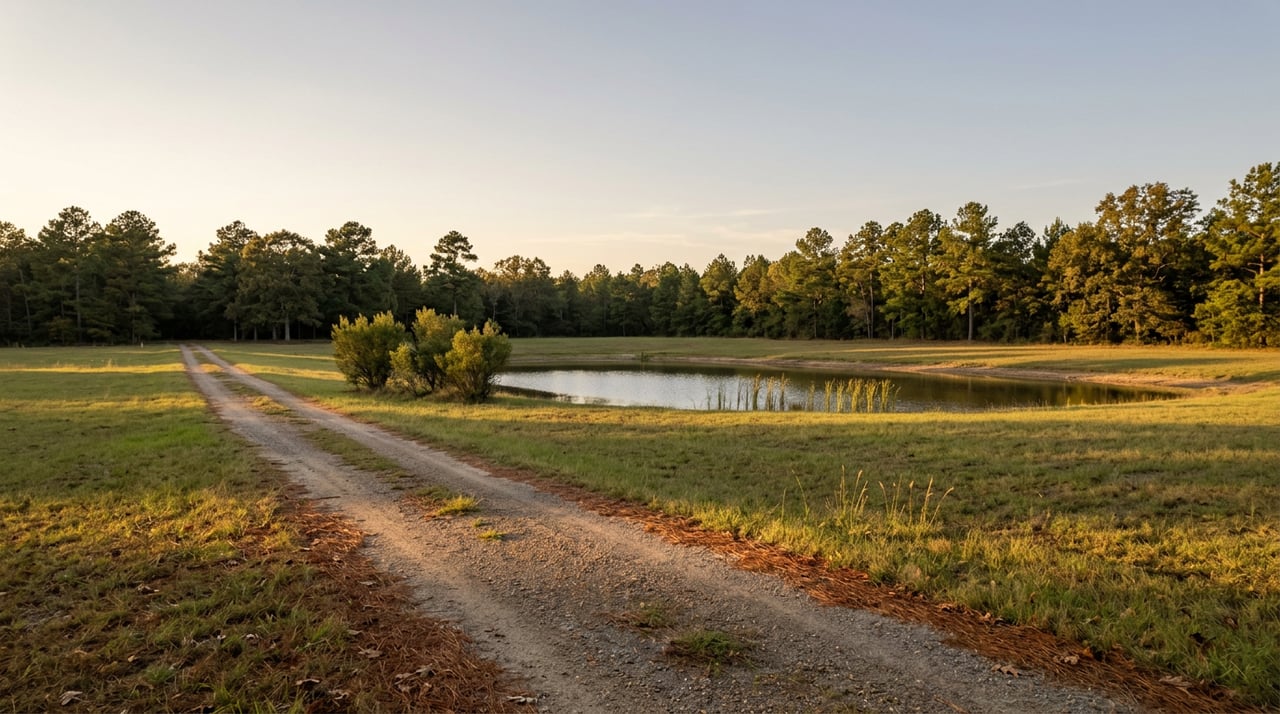
A tract just outside Claxton came up for sale not long ago that looked, on paper, like a deal. Forty-four acres, partially wooded, a pond with a dam, close to 1,800 feet of road frontage, and enough width that the listing noted it could likely be split into more than one homesite under the county's rules. Then, buried in the description, one line about a conservation-use covenant.
That single sentence changes what the tract actually costs to develop. It doesn't change the asking price. It changes everything that happens after closing if a buyer's plan involves a house, a subdivision, or anything other than farming or timber. This is the piece of Claxton's land market that never shows up in the number printed at the top of a listing, and it is worth understanding before you fall for a price per acre that looks better than it turns out to be.
What a Conservation-Use Covenant Actually Locks In
Georgia's Department of Revenue says that Georgia's Conservation Use Valuation Assessment, known as CUVA, lets landowners get their property taxed at its current agricultural or timber value instead of its full market value, as long as they keep the land in that qualifying use for ten years. The tax break is real. Landowners who enroll typically cut their property tax bill by something in the range of 40 to 80 percent compared to what they would owe at fair market value.
That is a meaningful incentive for a family holding acreage for hay, cattle, or planted pine. It is also a decade-long commitment attached to the deed, not the owner. If the land sells while the covenant is still running, Georgia's Environmental Protection Division says whoever buys it inherits the same restriction. They can agree to keep the land in its qualifying use and finish out the term, or they can break it. Breaking it has a price.
The Bill Nobody Puts in the Listing
Georgia's Department of Revenue and every county tax assessor's brochure describing the program state the penalty the same way: break the covenant early and you owe back double the tax savings realized over the life of the covenant, plus interest. On a small residential lot that might be a few thousand dollars. On a working farm or timber tract that has carried the covenant for eight or nine years, the number can run into five or six figures, and it becomes a lien against the property until it's paid.
Here's the part that catches buyers off guard: if the tract sells partway through the covenant and the new owner is the one who breaks it, they can be the one holding that bill. A buyer who plans to subdivide a covenant-protected tract into homesites right after closing isn't just paying the purchase price. They're also potentially picking up years of someone else's tax savings, due back with interest, the moment the county determines the qualifying use has ended.
None of this shows up in a property's asking price. It shows up in a title search, or in a direct call to the county tax assessor's office, or in the fine print of a listing description if the seller happens to include it. There's no separate line for it on the number printed at the top of the page.
Why the Price Per Acre Doesn't Match the Tax Bill
The gap between what land is assessed at and what it's listed for is exactly where this becomes visible in Claxton's numbers. Georgia farm real estate, the broad category that includes cropland and pasture statewide, averaged $4,720 per acre in 2025 according to USDA figures, up modestly from the year before. That's a current-use number, the kind of value a conservation covenant is built around.
Recent land listings inside Claxton itself tell a different story. A pool of roughly 550 acres currently for sale in the immediate Claxton area averages closer to $14,111 per acre, while a broader sample of listings across the wider market puts the median asking price nearer $357,000 per tract, a spread that widens fast once a handful of large, road-frontage-heavy parcels enter the mix. That dispersion is the tell. A tract priced at three times the statewide farm average isn't being sold for its hay or its pine straw. It's being sold for what it might become.
A 2026 land market report from a regional land brokerage found Georgia's rural corridors, the row-crop and timber belt that includes Evans County, averaging around $21,216 per acre, while land near metro areas averaged $43,836 per acre. Evans County sits on the rural side of that line by geography, but tracts advertised near Claxton at $14,000 or more per acre are already pricing in some of that metro-adjacent development premium. That premium is a bet that the land can be built on or split soon. A covenant with years left on it is the thing that decides whether a buyer can actually collect on that bet without paying a penalty to do it.
The I-16 Pull Underneath the Premium
That bet has a reason behind it. In July 2026, the Georgia Department of Transportation awarded a $468.35 million contract, the largest design-build contract in state history, to widen a 32-mile stretch of Interstate 16 running through Bulloch, Bryan, Chatham, and Effingham counties. Construction on the first phase is expected to start in 2027. The project is being funded specifically to keep pace with population growth and freight movement across southeast Georgia, and Evans County sits along that same I-16 corridor just south of the widening's western end.
Growth pressure along a corridor like that tends to pull land prices up ahead of the actual construction, because buyers are pricing in where development is likely to land next, not just where it already has. That's a reasonable instinct. It's also exactly why a covenant that locks a tract into farm or timber use for several more years matters more here than it would in a market with no growth story at all. The premium a buyer pays for development potential is only worth paying if the land is actually free to be developed on the buyer's timeline, not the covenant's.
Before You Write an Offer
A few questions are worth asking before a tract near Claxton gets past the letter of intent stage:
- Ask the seller directly whether the parcel carries a CUVA or Preferential Agricultural covenant, and if so, what year the current term started and when it expires.
- Confirm the answer independently with the Evans County Board of Tax Assessors, since covenant status is a matter of public record tied to the parcel.
- If a covenant exists and years remain, decide whether your plans can wait out the term or whether you need the land released now.
- If you need it released now, get a written estimate of the breach penalty before you finalize a price, and negotiate who covers it.
- Put the covenant status and the responsibility for any penalty in writing in the purchase agreement itself, not as a verbal understanding.
None of this requires a lawyer to spot. It requires knowing the question exists before you're three weeks into due diligence.
FAQ
Can I still live on land that's in a conservation-use covenant? Yes. Under O.C.G.A. § 48-5-7.4, Georgia law excludes the value of a residence from the covenant. The surrounding acreage stays under the agreement, but a house on the property doesn't disqualify the land.
Does inheriting covenant land trigger the penalty? According to TaxFightBack, inheritance usually does not trigger the penalty if the land passes to a qualifying heir who continues the same use. Where it gets complicated is when an estate has to sell the land to pay debts or to divide value fairly among heirs who don't farm. That kind of forced sale can trigger the breach penalty even though nobody involved wanted to develop the property.
Is every rural tract near Claxton in a covenant? No. Plenty of land in Evans County has never been enrolled, and plenty of covenants have already run their full ten years and expired cleanly. The only way to know for a specific tract is to ask and to check the record, which is a five-minute call most buyers skip because the listing never raises the question.
A tract's price per acre tells you what the seller wants. It doesn't tell you what you're free to do with the land the day after closing. That second answer lives in the county's records, not the listing description, and it's worth knowing before an offer goes in rather than after.
If you're looking at acreage in or around Claxton and want a straight read on what a specific tract can and can't do right now, Brown Land and Realty can pull the covenant history, walk the frontage, and tell you what the number actually means before you write an offer. Schedule a free consultation and bring the listing.
This article is general information, not legal, tax or financial advice. Consult a qualified professional about your situation.