If you are looking at development land in Claxton, it is easy to focus on price per acre and miss the details that really drive value. In a market like Claxton, investors tend to look past big promises and focus on whether a tract is usable, reachable, and realistic for the end use they have in mind. When you understand what matters most, you can evaluate land more clearly and avoid costly surprises. Let’s dive in.
Why Claxton land gets a practical review
Claxton sits in Evans County, where the county population estimate is 10,869 across 182.9 square miles. The county reports 236 employer establishments and 4,096 total employment, with key sectors that include manufacturing, healthcare, education, social service, retail, construction, and agriculture.
The City of Claxton describes its economy as a mix of agriculture, industry, and small business. In a setting like this, investors usually take a practical approach. They are often less focused on broad speculation and more focused on whether a property fits a real use, at a cost that makes sense.
Access matters first
Before an investor thinks about layout, buildings, or resale, they usually want to know one thing: can the tract be accessed legally and functionally? A parcel may look attractive on a map, but if access is limited or complicated, the deal can change quickly.
GDOT’s Claxton city map shows US 280/SR 30 running through Claxton, with SR 129 intersecting it. GDOT also shows planned widening and improvements along SR 30/US 280 from near Stewart Street eastward through downtown Claxton to Cedar Street, with a planned five-lane section over about 1.5 miles.
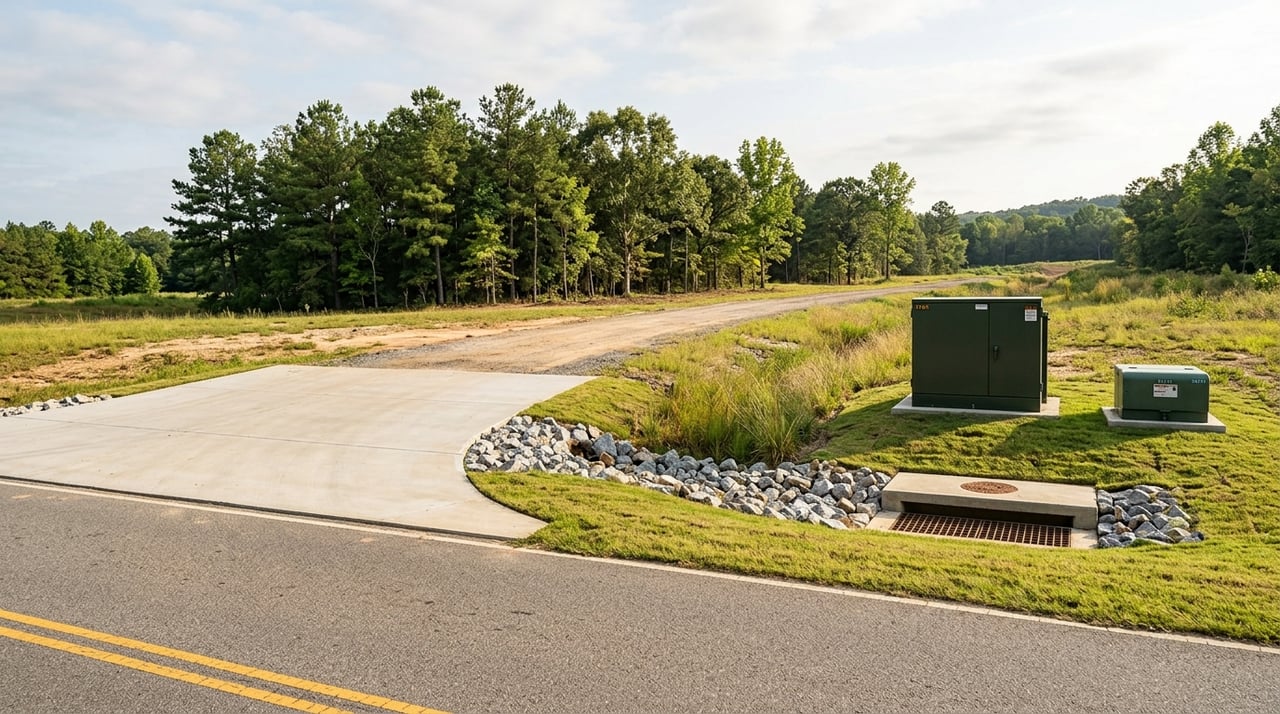
That makes road frontage, visibility, turning movements, and access design especially important. For land along or near key corridors, investors will often look closely at:
- Frontage length
- Corner visibility
- Existing curb cuts or driveway potential
- Traffic flow and turning access
- Whether access changes could affect the site plan
If a tract may be subdivided, Evans County’s ordinance materials also make road and driveway rules part of the conversation. The county subdivision ordinance states that plats and construction plans must be reviewed before filing, which is why experienced buyers treat access as a due diligence item from day one.
Utilities can reshape the whole deal
A parcel can have strong location appeal and still fall short if utility service is too expensive or too uncertain. In Claxton, utility questions are not just a box to check. They can materially affect what a site can support and what it will cost to develop.
The City of Claxton’s utility-services application includes water, sewer, sewer tap, and natural gas service. That confirms that municipal utility connections are part of the local development picture for properties served by the city.
Investors usually want answers to a few basic utility questions early:
- Is the property inside city service area or outside it?
- Are water and sewer available now?
- What tap fees or extension costs may apply?
- Is natural gas relevant to the intended use?
- Who is the electric service provider?
Evans County also publishes an electrical permit ordinance requiring purchasers to meet the electric provider’s requirements. In simple terms, nearby utility lines do not always mean easy service. Service availability, provider standards, and connection costs all need to be confirmed before numbers on paper become a real plan.
Drainage and flood risk affect buildability
In development land, not every acre is equal. A tract may appear large enough for a project, but drainage issues or flood-related restrictions can shrink usable area and increase site-work costs.
Claxton’s code says subdivision and development proposals should minimize flood damage, place public utilities in ways that also minimize flood damage, and provide adequate drainage. That means low-lying land or land near a drainage path may require more engineering, more grading, or a different layout than a buyer first expected.
For investors, this is a major underwriting issue. If the site needs added drainage work or utility design changes, project costs can rise quickly. That is why many buyers look beyond acreage totals and ask how much of the tract is truly functional for the intended use.
Zoning and jurisdiction guide the next step
One of the first questions investors ask is whether the land is inside the City of Claxton or in unincorporated Evans County. That single fact can shape the approval path, the governing rules, and the likely timeline.
Claxton’s code authorizes planning and zoning regulations, including a zoning commission and board of zoning appeals. The city also lists a City Zoning Map and City Zoning Ordinance and identifies a zoning administrator among local officials.
So if a parcel is inside city limits, investors typically start with these questions:
- What zoning district applies?
- Is the intended use allowed?
- Would a variance or rezoning be needed?
- Are there development standards that limit the concept?
Outside city limits, Evans County’s subdivision ordinance governs unincorporated land. The ordinance states that the county administrator approves or disapproves preliminary and final plats and construction plans, and that no subdivision plat may be filed without prior stamped approval of the Board of Commissioners.
That is why investors usually do not assume that a tract can be split, replatted, or repositioned without formal review. Local approvals are a core part of land value, not a side note.
River buffers and overlays can reduce usable land
A tax map may show one acreage number, but development potential can be smaller once overlays and restricted areas are considered. This is especially important for parcels near waterways.
Claxton’s code includes a protected river corridor and a 100-foot buffer along the Canoochee River within the county, with development restrictions in that area. For some properties, that can reduce where improvements may be placed and how much land is truly available for the planned use.
This is one reason investors often focus on usable acreage rather than gross acreage. A tract with fewer total acres but fewer constraints may be more valuable than a larger property with major limitations.
Investors underwrite end-use fit
In Claxton, investors are often asking whether the local market supports the specific project type they want to build or hold. Evans County describes itself as a growing community with a diverse economy, but it remains a relatively small market by population and employment base.
That usually leads practical buyers toward measured decisions. Based on the available county data, smaller-scale projects that can be phased and absorbed gradually are often easier to defend than large speculative builds that depend on rapid broad growth.
This does not mean larger opportunities never work. It means buyers tend to study whether the tract matches local demand, utility economics, road access, and approval requirements before they stretch on size or scope.
What serious buyers check before closing
Most investors reviewing development land in Claxton are really underwriting five questions at once:
- Can the property be reached legally and designed with workable access?
- Can utilities serve the tract at a reasonable cost?
- Can the parcel be entitled for the intended use?
- Will drainage, flood risk, or buffers create extra expense?
- Does the Claxton market support the end use?
Those questions sound simple, but each one can affect price, timeline, and risk. A property that looks attractive at first glance may not stay attractive once site constraints and approval steps are fully understood.
A practical Claxton land checklist
If you are comparing development tracts in Claxton or Evans County, this checklist can help you think like an investor:
- Confirm whether the parcel is inside city limits or in unincorporated county jurisdiction
- Check current zoning or permitted use
- Review road frontage, driveway rules, and sight-distance considerations
- Ask about water, sewer, sewer tap, natural gas, and electric service requirements
- Look into floodplain, drainage, and low-lying areas
- Identify any protected river corridor or buffer concerns
- Verify whether the tract can be subdivided without a variance or rezoning
- Compare usable acreage, not just total acreage
- Match the site to a realistic end use for the local market
Why local guidance makes a difference
Development land is rarely just about location. In Claxton, it is also about frontage, utility service, drainage, jurisdiction, and whether the tract can actually support your plan.
That is where local, technical experience matters. Brown Land & Realty brings a practical understanding of land utility, homesites, land division, development support, and property potential across Southeast Georgia. If you are weighing a tract in Claxton and want help looking at the details that matter, schedule a free consultation with Brown Land and Realty.
FAQs
What do investors look for in Claxton development land first?
- Investors usually start with legal access, road frontage, utility availability, zoning, drainage, and whether the site fits a realistic end use in the Claxton market.
How important is road frontage for development land in Claxton?
- Road frontage is very important because access, visibility, turning movements, and driveway design can directly affect how a tract can be used and how valuable it is to a buyer.
Do Claxton development land buyers need to check city or county rules?
- Yes. Investors usually confirm whether a tract is inside the City of Claxton or in unincorporated Evans County because the governing rules, approval path, and development standards may differ.
Are utilities available on all development land in Claxton?
- Not necessarily. Buyers should verify water, sewer, sewer tap, natural gas, and electric service requirements for the specific parcel instead of assuming service is easy just because lines appear nearby.
Can drainage issues affect Claxton land value?
- Yes. Claxton’s development rules address flood damage prevention and adequate drainage, so low-lying land or land near drainage paths may require added work that changes project costs and buildability.
What should you ask before buying development land in Evans County?
- You should ask about zoning, legal access, driveway requirements, utility costs, drainage or flood concerns, river-buffer restrictions, and whether the plat or intended use can be approved without a variance or rezoning.